What is an offset account? - NAB


Understanding offset accounts
An offset account is a transaction account linked to an eligible variable rate home loan. The money in that account reduces the amount used to calculate interest, helping you pay less interest while keeping access to your money. The more money you have in the offset account, the less interest you pay on your home loan.
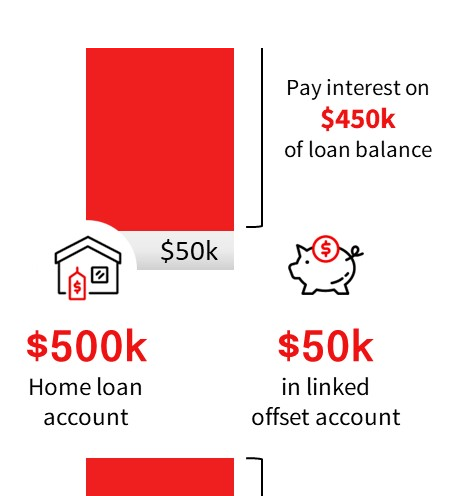
For example, if your home loan balance is $500,000 and you have $50,000 in your offset account, you’ll only pay interest on $450,000. Your loan balance is still $500,000; the money in your offset hasn’t been used to repay it.
Your potential interest savings depend on your offset balance and how long you keep money there.
Can I have multiple offset accounts?
Yes, you can link up to 10 offset accounts to an eligible variable rate NAB home loan. Multiple offset accounts let you keep money in separate transaction accounts while using their combined balance to reduce your home loan interest.
You might use one account for everyday spending, another for bills and another for a holiday. This can help you organise your money without missing out on the offset benefit.
It’s the total offset balance that affects your interest savings, not the number of accounts. Splitting the same amount across several linked offset accounts has the same offset effect as keeping it in one.
Learn more about multiple offsets and bucketing your money.
How offset accounts work
Let’s illustrate with an example. Jenny and Lisa each have a $500,000 home loan with a 30-year term and a 5.0% p.a. interest rate. Let’s compare Lisa’s loan without an offset account with Jenny’s loan using one offset account, then multiple offsets.
1. Without an offset account
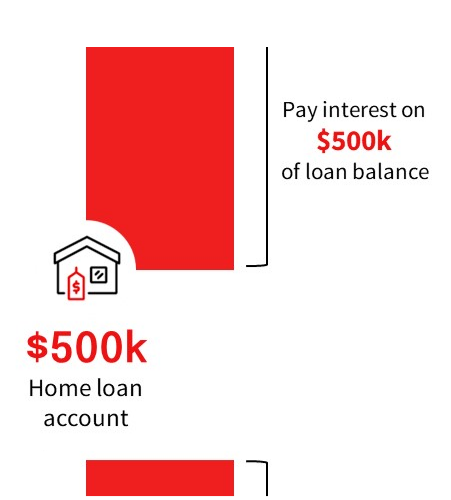
Lisa has no linked offset account, so interest is calculated on her full $500,000 home loan balance.
2. With a single offset account
Jenny has $50,000 in one linked offset account. Interest is calculated on $450,000: her $500,000 home loan balance minus her $50,000 offset balance.
3. With multiple offset accounts
If Jenny has three linked offset accounts with a combined balance of $65,000, interest is then calculated on $435,000.
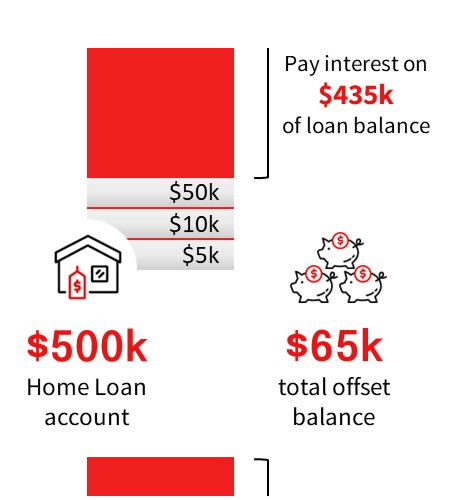
In the multiple offsets example, Jenny saves more interest because she has an extra $15,000 in her offsets, not because she has more accounts. These examples show how offset balances affect the amount used to calculate interest. They don’t show total savings over the loan term.
What’s the difference between offset and redraw?
An offset account keeps your money separate from your home loan and available for everyday banking. Redraw lets you access eligible extra repayments you’ve made into your home loan, subject to your loan’s terms and conditions.
Both can help reduce home loan interest, but how you access your money differs.
Benefits of multiple offset accounts
Reduce your interest
Money in your linked offset accounts reduces the balance used to calculate your home loan interest. This can help you save on interest while keeping your money available.
Help repay your loan sooner
If you make principal and interest repayments and keep your repayment amount the same, paying less interest means more of each repayment goes towards your loan balance. This could help you pay off your home loan sooner.
Keep your money organised
With multiple offsets, you can separate money for bills, everyday spending and savings goals. The combined balance still works towards reducing your home loan interest.
Things to consider
Your balance affects your interest savings
As money comes in and goes out of your linked offset accounts, your combined balance changes. The lower your combined balance, the less home loan interest you save.
Interest saved not earned
While your transaction account is linked as an offset, your money helps reduce your home loan interest instead of earning interest on its balance.
Compare the costs as well as the benefits
When comparing home loans, consider the interest rate and any fees alongside the potential offset savings. The amount you expect to keep in your offset accounts can help you assess the overall cost.
Deposit protection has a combined limit
Offset accounts that are separate deposit accounts are covered by the Financial Claims Scheme (FCS). The limit is $250,000 per account holder, per authorised deposit-taking institution, across all eligible deposits. It isn’t a separate $250,000 limit for each offset account.
Don’t have a home loan with us?
View our variable rate home loans with offset. Learn about the features and benefits of what our home loan can offer you and apply today.
How to get the most out of your offset accounts
How you use your accounts can affect the interest you save. Here are a few options to consider.
Calculate your potential interest savings
Use our loan repayment calculator to explore how an offset balance could affect your interest savings and loan term.
Try a balance that reflects what you expect to keep in your offsets, rather than your highest balance. Calculator results are estimates, not a guarantee of savings.
Keep savings in your offsets
Money set aside for bills, emergencies or other goals can help reduce your home loan interest while it stays in a linked offset account. You can still access it when you need it.
Have your salary paid into your offset
Having your salary or other income paid into a linked offset account can help reduce your home loan interest until you spend or transfer the money. You can use the NAB app to share your account details with your employer or another income provider.
Check your linked accounts
Check that the eligible accounts you want to use as offsets are linked to your home loan. Opening a transaction account doesn’t automatically make it an offset account. You can view your linked offset accounts and interest saved in the NAB app.
Which accounts and home loans are eligible?
You can reduce the interest charged on your home loan by linking an eligible transaction account to an eligible variable rate home loan, subject to the following conditions:
- Only eligible variable rate home loans can have eligible NAB tailored transaction accounts, such as the NAB Classic Banking account, linked to offset the interest charged on the home loan.
- During the fixed rate period of your home loan the offset feature is not available. This option becomes available once your home loan fixed rate period expires and rolls to an eligible variable rate. You can then link an eligible transaction account for offset purposes.
- A linked transaction account needs to be set up with the same name as the borrower on the home loan for the offset to function. For joint borrower home loans, individually held transaction accounts may be linked by each borrower. As well as transaction accounts held by both borrowers. If a transaction account isn’t held in the name of a borrower, it cannot be linked as an offset.
- An eligible variable rate home loan can have up to 10 eligible linked transaction accounts, to offset the home loan. However, each eligible transaction account can only be linked to offset one home loan at a time.
How to set up an offset account
- Check your home loan is eligible.
- Open an eligible transaction account or link an existing account.
- Link your offset account to your home loan.
Explore other life moments

The difference between redraw and offset
Compare your redraw facility and offset accounts to learn how they can work in different ways to help you meet your goals.

Types of home loans
We explain all of our different loan types and packages.

Understanding the loan to value ratio (LVR)
We explain how Loan-to-Value Ratio works. Read more.
Related products and services
Savings accounts
Whatever you're saving for, our savings accounts can help get you there sooner.
Credit cards
Compare between our credit cards to find the right one for you.
Home loans
Home loans for every need with tools, calculators and guides to help you choose.
Contact us for home loan related queries
This is how you can get in touch.
Start a conversation with a banker
- Log into either NAB Internet Banking or the NAB app.
- Tap on the message icon.
- Type ‘speak to a person’ in the conversation window.
Call us
Speak to a home loan expert about a new or existing home loan.
Monday to Friday, 8:00am to 7:00pm (AEST/AEDT)
Saturday to Sunday, 9:00am to 6:00pm (AEST/AEDT)
Book an appointment
Make an appointment to see us at your nearest branch, ask a mobile banker to come to you or ask us to call you back.
Terms and Conditions
Apologies but the Important Information section you are trying to view is not displaying properly at the moment. Please refresh the page or try again later.
Information is current as at 10 February 2025 and is subject to change.
The information contained in this article is intended to be of a general nature only. It has been prepared without taking into account any person’s objectives, financial situation or needs. Before acting on this information, NAB recommends that you consider whether it is appropriate for your circumstances. NAB recommends that you seek independent legal, financial and taxation advice before acting on any information in this article. Please consider the relevant Terms and Conditions for the products referenced in this article available from nab.com.au or from NAB before making any decisions regarding our products.
Terms, conditions, fees, charges, eligibility criteria and lending criteria apply. Only eligible NAB Home Loans can benefit from an interest offset arrangement including the NAB Tailored Variable Rate Home Loan. For example, Fixed Rate Home Loans and Base Variable Rate Home Loans with NAB do not benefit from an interest offset arrangement. You will not earn interest on the account balance of your transaction account whilst it is linked to a home loan under an interest offset arrangement.
Target Market Determinations for these products are available at nab.com.au/TMD.
NAB’s home loan, deposit and credit card products are issued by National Australia Bank Limited ABN 12 004 044 937 AFSL and Australian Credit Licence 230686.