Explore EOFY planning considerations for agribusiness, including Farm Managed Deposits and ways to use surplus funds effectively.
Future-ready growth in horticulture - NAB

15 June 2026
Agribusiness
Adaptation, innovation and risk: Insights from Hort Connections. Two SA leaders share how sustainability, tech and bold investment are reshaping growth beyond domestic markets.
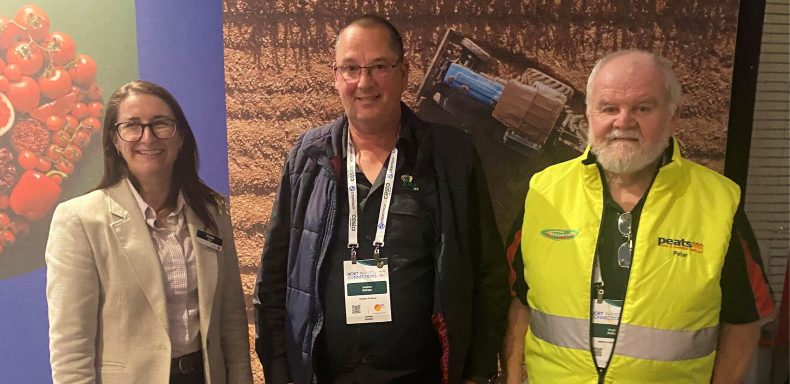
At this year’s Hort Connections conference, two South Australian business leaders and NAB customers shared what it takes to build a future-ready horticulture business.
In an interview led by NAB Agribusiness Executive, Josie Zilm, Peter Wadewitz of Peats Soil and Garden Supplies, and Andrew Braham of Braham Produce discussed how a willingness to adapt have shaped resilient businesses.
“Future-ready businesses aren’t built overnight - they’re built through taking a bit of a risk, being ready to pivot, curious leadership and long-term thinking,” Josie said.
That theme played out across two very different, but equally instructive growth stories appreciated by the audience at Hort Connections in Adelaide this month.
Growth through adaptation
For Peter Wadewitz, Managing Director of Peats Soil and Garden Supplies, success has been built on decades of innovation.
“An instant success after 50 years,” Peter joked.
What began in 1973 with Peter using a shovel and a trailer to collect woodchips from timber yards has grown into a large-scale circular economy business employing more than 100 people and operating a fleet of trucks.
“I have two grandkids who want to take over the business which is really exciting,” Peter said.
Today, the business transforms green waste into compost, soils and mulches, turning a disposal challenge into a valuable resource for agriculture, horticulture and landscaping. Peter credits that evolution and success to a willingness to keep adapting.
Rising fertiliser prices, driven in part by global instability most recently stemming from ongoing conflict in the Middle East, have proven to be a disruption that has created opportunity.
“Every time fertiliser prices go up, we get a lift in customer inquiries and demand for organics,” Peter said.
“I say to my grandkids, there’s always a challenge or disaster to navigate through.”
A key innovation for the business has been the development of on-site organic waste processing systems, allowing customers, including councils and large agricultural operations, to manage waste streams locally while improving soil outcomes.
This model effectively exports intellectual property and process rather than just product, with the business most recently exporting its technology to Indonesia.
Growing from the ground up
Andrew Braham’s journey into horticulture followed a different path from Peter’s, but one defined by the same principles of calculated risk and continuous improvement.
Starting in the transport industry when he was just 18, Andrew moved into horticulture after meeting his wife Zurriyet, whose family were growers.
What began as a side venture has evolved over 26 years into a business that now produces premium capsicums (bell peppers) in greenhouses for major market agents.
Based in Virginia, South Australia, the business employs 10 people and is now entering its second generation with Andrew’s son recently joining the business.
For Braham Produce, growth has been driven by investment in cutting-edge technology, biological systems and supply chain reliability. Most recently, Braham Produce has had to navigate disruption following the outbreak of tomato brown rugose fruit virus (ToBRFV) in South Australia in 2024. The exotic fruit virus impacts tomato and capsicum crops.
Its discovery in SA restricted interstate trade and forced growers to operate within state borders.
“It was a really bad thing for us and for all South Australian growers because it basically locked us out of interstate trade,” Andrew said.
The response by the industry was rapid and collaborative.
“Growers might not know everything at the start, but they’re the first to step up, learn quickly and find solutions because it directly affects them,” Braham said.
“Growers worked together, drawing on international knowledge and sharing insights to contain and manage the issue.
“That ability to collaborate and adapt ensured the industry could recover and move forward.”
In October 2025, the South Australian government declared the State free of ToBRFV.
Looking ahead
What emerged clearly throughout the discussion at Hort Connections was that there is no single pathway to becoming “future ready” in horticulture. Instead, success is contingent on aligning businesses with market demands and having the ability to navigate challenges.
For Peats Soil and Garden Supplies, this has meant anticipating the global move toward circular economies and embedding sustainability into the core offering.
For Braham Produce, it has meant pushing the frontier of controlled environment agriculture to meet rising expectations around quality and provenance.
“It’s a privilege to represent NAB at a conference that celebrates the leadership, innovation and resilience of the horticulture industry,” Josie Zilm said. “We’re seeing enormous change across horticulture, from technology and automation, to sustainability, workforce pressures and changing consumer expectations.”
“Future ready businesses aren’t built overnight,” she said. “They’re built through curious leadership and long-term thinking.”
“We’re proud to partner with horticulture businesses, like Peter and Andrew’s, across their journey, from funding innovation and automation, to supporting resilience through change,” she said.