
Discover how US digital infrastructure and energy funding gaps are creating private capital opportunities in the next generation of AI facilities.
Connecting with business customers through AI - NAB


31 July 2026
Corporate and Institutional
 Smart decisioning engines can help organisations shape better interactions with customers. Getty
Managing more effective and relevant communications with a significant customer base in real time is a valuable growth opportunity NAB shares with a range of corporates and institutions today.
By harnessing the power of AI-based technologies across a vast pool of banking and behavioural data, NAB is able to understand customers better while providing highly-personalised and adaptive experiences to add value - whether digitally, on a call or in person.
Lisa Marchant is NAB Executive, Customer Decisioning and Data Science, and says her priority today is to drive the rapid scaling of the bank’s central customer engagement engine, known as NAB’s Customer Brain or simply “the Brain”.
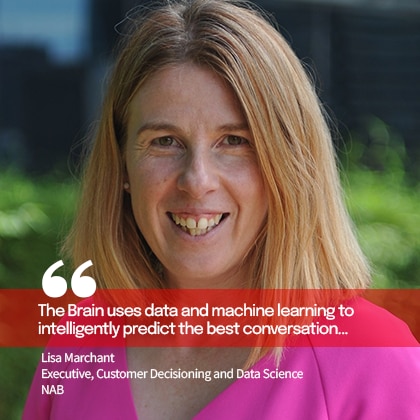
“The Brain uses data and machine learning to intelligently predict the best conversation to have with our customers at an individual level,” Marchant says. “This means we’re able to interact in the right way, at the right time, with the right customer and to do this at scale.”
The process is known as “decisioning” which is the automated analysis of real-time customer signals and other data using a set of business rules to determine the “next best action” to take when interacting with a customer in their preferred channel.
The Brain now has more than 550 of these actions live in the system, running across a suite of about 10,000 rules, 1200 customer data attributes and 3500 adaptive machine learning models which process customer signals in real time.
“With 98% of customer interactions now digital, it means we have lots of data points on what matters for our customers. The Brain allows us to join the dots between those points and understand how best to serve their individual needs,” Marchant says.
With NAB research showing 44 per cent of small and medium business owners cite cash flow as their top concern, it remains an important area for brokers to keep front of mind as customer circumstances evolve.
Shifts in trading conditions, growth plans, investment decisions and the broader operating environment can all change how much working capital a business needs, and when.
For commercial brokers, spotting those changes early can help shape more proactive conversations with customers.
Marchant says implementing the project over the past four years has involved a complex process of change management, helped by strong top-down executive support.
The initial set-up involved organising the foundational internal data layers and integrating the Brain into NAB channels. The pool of data includes formal, structured records like spreadsheets and accounts as well as exploring the use of unstructured information like call centre transcripts and web chat interactions.
Marchant says while some of the initial Brain actions had been almost one-off marketing campaigns, the focus now is thinking about a series of micro “nudges” aimed at providing a strong, positive experience across the entire journey.
To help achieve greater scale, with more granular, high-quality decisioning, the team is harnessing the power of generative AI to rapidly grow the Brain’s decisioning library from hundreds of next best actions to thousands.
“Instead of starting from a blank page, we can describe what we want to do in plain language and the generative AI designs the workflows in seconds,” she says. “The systems we use bake in industry best practices and proven patterns to achieve a high quality from the start.”
Marchant says using the AI compresses the build, testing and deployment cycle of new decisioning actions from days to hours while maintaining the layer of human oversight from data scientists in line with NAB’s wider data ethics, security and governance frameworks.
The team is also working on agentic AI solutions to develop autonomous workflows around customer conversations as well as for identifying additional opportunities to connect.
A recent success came when analysis of the home lending portfolio uncovered extra moments to engage with customers over the whole mortgage lifecycle rather than simply the traditional start and end points.
Marchant says the rate of active engagement with these customers has now lifted from about 20% to 75%, as the Brain guides and fills the gaps in the customer journey.
“It’s about making sure we always have something to say to a customer and can connect with them proactively,” she says. “Some of the actions today may include simple birthday wishes, celebrating mortgage or savings milestones, or giving them property insights and information about new features in the mobile app.”
More complex use cases include step-by-step transaction dispute resolution, better onboarding experiences, and connecting appropriate customers to bankers in home lending using data analytics, leading to a clear uplift in opportunities to help more customers into homes.
While acknowledging the Brain as a major technology investment, Marchant says today’s smart decisioning engines can help organisations understand their customers better. She says it’s especially relevant where scale is needed - in areas like healthcare, telecommunications, insurance, retail and travel for instance.
“More and more customer interactions today are digital, which leave data footprints that can then be activated to provide a really strong customer experience. Helping our customers like this, providing service and solutions first, builds trust and loyalty which ultimately drives greater business success.
“We’re continuously refining these processes to optimise what’s working and enhance the moments that matter for our customers. It’s why the Brain is a core pillar of our enterprise ambition to be the most customer-centric company in Australia and New Zealand. With the right foundations in place and the latest technology, we’re ready to do even more.”