Global growth eased in Q1 and another modest outcome looks likely in Q2.
Five economic signals shaping Australia’s business outlook - NAB


Consumer spending, housing, inflation, employment and geopolitics are the five economic signals NAB Chief Economist Dr Sally Auld is monitoring closely.
NAB data points to a slowing economy, although activity has remained more resilient than many anticipated.
Since stepping into the role of NAB Chief Economist in March 2025, Dr Sally Auld has met with customers across the economy, helping them navigate today’s increasingly complex and uncertain environment.
Drawing on insights from customer conversations, NAB's Business Survey and spending data, Dr Auld says the economy is slowing, but not as sharply as many feared earlier in the year.
While volatility remains elevated and forecasting requires humility, she says five areas are particularly important to watch in the months ahead: consumer spending, housing, inflation, employment and geopolitics.
"At the end of the day we rely on data and judgment to make our calls," Dr Auld says.
"What gives us the confidence of a slight edge is we have access to reports like the NAB Business Survey and our own spending data, along with insights from individual customer meetings.
"It all gives us a lot of on-the-ground feedback, which is very motivating, and a useful source of evidence when shaping our views."
The latest NAB data suggests consumer spending - or what households are doing - has held up better than expected amid cost-of-living challenges. Dr Auld says the next few months will be important in assessing the underlying trend and how it impacts the economy.
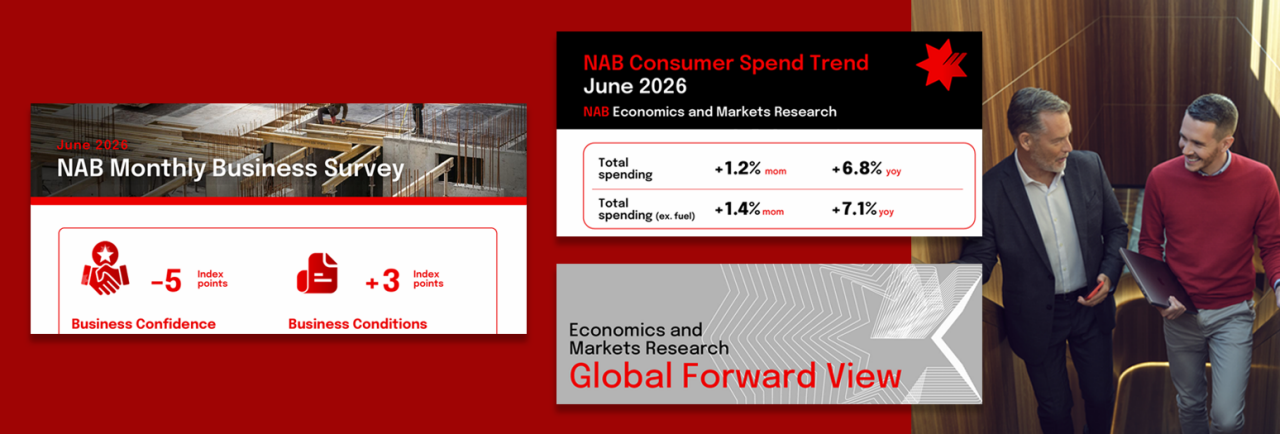
The NAB Consumer Spend Trend report for June shows spending rose 1.2% across the month and 6.8% over the year, while spending excluding fuel was up 1.4% in the month and 7.1% year-on-year.
Despite the strong result, spending growth overall eased slightly in the June quarter, to 1.5% from 1.7% in the March quarter. Growth over the year has been driven by essential spending, particularly utilities and telecoms as energy bill rebates ended. Discretionary spending grew 6.6% over the year.
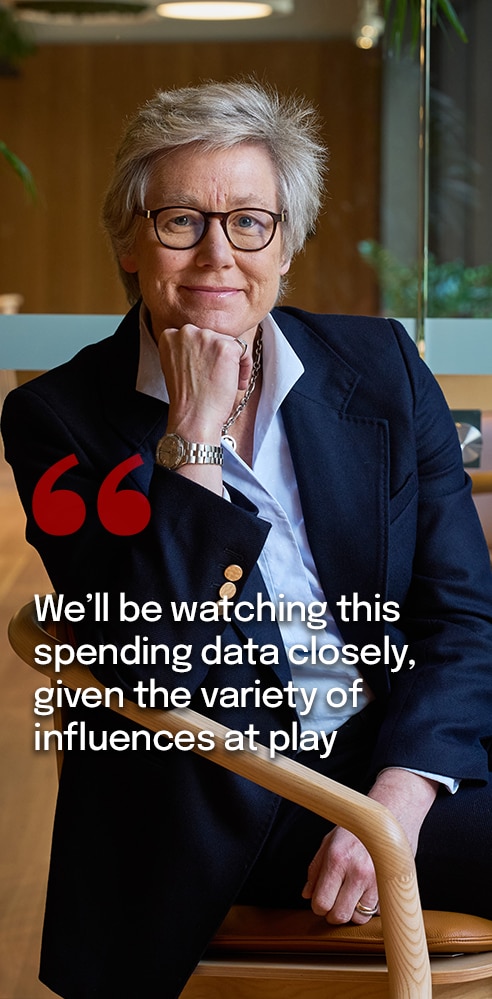
"We’ll be watching this spending data closely, given the variety of influences at play," Dr Auld says.
"There is a chance that falling house prices in major capital cities dampens the consumption story a little, and the recent escalation in the Middle East conflict may pressure petrol prices higher, which could slow discretionary spend."
NAB expects consumer spending growth to slow over the rest of the year as momentum in the broader economy moderates.
NAB has already made downward revisions to housing credit growth and dwelling price growth expectations as the market responds to changes included in the Federal Budget. Dr Auld says the slowdown in the housing market, evident through weaker prices and lending growth, means these revisions could continue if auction clearance rates stay down, particularly in the capital cities.
More broadly, as turnover falls she expects to see multiplier effects ripple through the economy in a reversal of the noted “wealth effect” where rising house prices increase consumer confidence and spending. The effect in reverse means that the slowdown in house prices should dampen consumption growth – especially across cyclically sensitive areas like car sales – and also impact housing-associated businesses, from real estate to conveyancing, removals and home improvements.
"The current forecast is for the capital city average to be down 2% year-on-year by the end of 2026," Dr Auld says.
"That’s mostly a Melbourne, Sydney story where we expect those capital city house prices to be down 6% or 7% year-on-year.
"But when we look at six-month annualised growth, we’re already at 7% for both of those capitals. So, clearly if prices keep falling we’ll have to revise those numbers down."
The NAB Business Survey for June shows business conditions remain below average, with employment slightly softer, profitability improving and trading conditions broadly unchanged. Capacity utilisation for the month was steady at 82.0%.
"Inflation is the dominant policy concern for the RBA at the moment because it’s still too high," Dr Auld says.
"From an inflation perspective, our latest survey is encouraging. The March cost growth spike has largely unwound, and price growth has moderated across most industries. But of course, with oil prices already up 30% so far in July, it might be premature to be too confident to conclude that the worst is behind us on oil-related price impacts.
"Labour costs remain elevated and margins are still under pressure, but the broader trend is towards easing capacity constraints and more moderate price growth.
"While we expect inflation to remain elevated over the next 12 months. we do think that in a sequential, or quarter-by-quarter context, we will start to see some gradual improvement in the inflation story from here on. However, recent developments in the Middle East means that this improvement may be even more gradual than we currently anticipate."
NAB expects the central bank’s next easing cycle to start in May 2027, as inflation is slowly brought back in line with the target band of 2% to 3%.
Stronger than expected labour market figures for June showed a jump in employment to 76,300 for the month1, keeping the unemployment rate at 4.4% and prompting some renewed market speculation of another interest rate rise.
Dr Auld says NAB’s expectations are for the unemployment rate to drift higher over the back half of this year and into next, noting some early evidence of softening.
"The labour market is starting to get a bit interesting," she says.
"We had that period where the unemployment rate was bouncing between 4.1% and 4.3% for about six months and not doing very much. We’ve broken that range now, for the past three months, shifting up slightly.
"It’s not a big increase but it tells you we’re now on a path where it looks like the unemployment rate is going to drift higher."
Dr Auld says the RBA has the unemployment rate peaking at 4.6% for the cycle, which she feels is now perhaps too low.
"What could be interesting is if it all starts to unravel a bit more quickly and 4.6% just looks too low for the RBA. If we saw that in the commentary, I think we’d be pretty comfortable that the RBA is done hiking rates, which is in line with our current expectations."
Beyond domestic economic trends, geopolitical developments are increasingly shaping business confidence, supply chains and operating conditions.
The Deloitte CFO Sentiment survey for 1H 20262 puts global instability as the top external disruptor of concern for senior finance executives over the next 12 months, just ahead of inflation.
June’s quarterly statement from the Council of Financial Regulators (CFR) also places the issue front and centre, noting the Australian financial system “has remained resilient, but international risks are elevated” while issuing a strong signal to industry on preparedness3.
Dr Auld says one key concern for business here is supply chain fragmentation, seen sharply across the pandemic and in the most recent disruptions around the Strait of Hormuz, which have again seen the price of oil head above US$100 a barrel.
She says the changing environment, with a growing recognition of a shift in the stability of the world order enjoyed over recent decades, means businesses relying on goods from offshore need to lock in long-run supply and probably hold higher levels of inventories than might have historically been the case.
"The situation means businesses have to optimise for resilience and risk management rather than just efficiency, as we’ve been used to doing in recent decades with the free movements of goods and labour and capital associated with globalisation," Dr Auld says.
"It means we’re in a world today where the cost of doing business is now higher."
The latest addition of more tariff challenges from the US is another example of the realities of this more volatile and nation-centric environment.
Overall, however, Dr Auld says the silver lining is that in the next 12 months economic conditions will have improved, with inflation coming down and rates easing under current expectations.
"Of course, this is not without risk, and we have to be humble in our forecasts," she says.
"But we certainly do hope to see inflation back sustainably within the 2% to 3% target band this time next year, which will help enormously with the current challenges.
"There’s certainly a lot to like about Australia, and from what our customers are telling us there’s an underlying sense of optimism about the future from where we are today. We look forward to seeing this come through with improved economic conditions as we head into the 2027/28 financial year."
For all media enquiries, please contact the NAB Media Line on +61 3 7035 5015